BitVault Raises $2M from GSR, Gemini, and Auros to Launch BTC-Backed Money

Berlin, Germany, June 18th, 2025, Chainwire

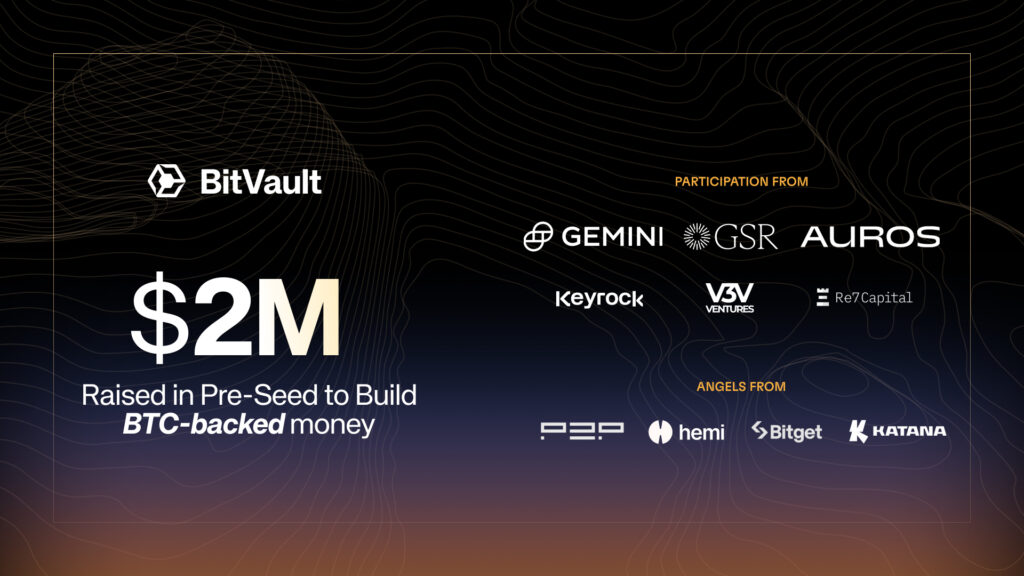
BitVault, a DeFi protocol aiming to redefine Bitcoin’s role in stablecoin infrastructure, has announced the close of a $2 million pre-seed round. Strategic investors include GSR, Gemini, Auros, and Keyrock, among others—joining BitVault in building what it calls the “next era of BTC-backed money”: an institutionally-aligned alternative to fiat-pegged stablecoins.

The raise supports the launch of bvUSD, BitVault’s overcollateralized stablecoin backed by Bitcoin derivatives, and sbvUSD, its yield-bearing variant powered by institutional trading strategies by GSR.

BitVault will serve as a core stablecoin protocol on Katana, a new DeFi-first chain incubated by Polygon Labs and GSR prioritizing deep liquidity and user rewards, leveraging a licensed fork of Liquity V2 to enable permissioned borrowing, user-set interest rates, and automated liquidation infrastructure.

“Bitcoin was built for moments of fracture. BitVault was built to make it usable,” said Michael Kisselgof, Core Contributor of BitVault and VaultCraft. “We specifically onboarded GSR, Auros, and Keyrock as strategic investors that can also execute high yielding, non-directional strategies to create demand and deep liquidity for BTC-backed money.”

Stablecoins at an Inflection Point

BitVault arrives amid rising demand for crypto-native stability in a fragmented global monetary environment. Unlike fiat-backed stablecoins like USDC or algorithmic options like Ethena’s USDe, bvUSD is collateralized by BTC derivatives.

Only whitelisted institutional borrowers can mint bvUSD in bulk, while anyone can mint bvUSD using stablecoins—mitigating risks associated with overleveraged or anonymous borrowing. DeFi users can earn yield by staking bvUSD into sbvUSD, which leverages delta-neutral and arbitrage strategies managed by GSR, a globally recognized crypto investment firm specializing in market making, OTC trading, and options..

“We’re seeing growing interest in BTC-backed stablecoins, especially those designed to integrate seamlessly into DeFi ecosystems,” said Alain Kunz, Director from GSR, who participated in the round. “BitVault’s approach with experience in institutional-grade yield strategies positions it well for success. We’re particularly excited about its deployment on Katana, a DeFi centric chain we helped incubate. BitVault adds to Katana’s evolving ecosystem by introducing a new layer of stablecoin utility, enabling BTC to take on a more productive role within Katana’s high-yield DeFi stack.”

From Liquity to Katana

BitVault is a friendly fork of Liquity V2, re-engineered for institutional use under a licensed deployment agreement with Liquity AG. The protocol blends automated, governance-free mechanisms with a permissioned borrowing layer, offering stability while retaining core DeFi primitives like direct redemption and composable yield strategies.

Its upcoming VCRAFT token will govern future protocol parameters and serve as a rewards mechanism for stability providers and liquidity contributors.

The launch on Katana, incubated by Polygon Labs and GSR, positions BitVault at the heart of an emerging liquidity and settlement network across the EVM chain. Initial integrations include Vault infrastructure, Morpho money markets, Sushi AMMs, and a multichain “Bits” points campaign tied to VCRAFT distribution.

What’s Next

BitVault is scheduled for mainnet deployment on Katana in June 2025, with broader integrations across DeFi ecosystems and centralized liquidity venues in the works. The team plans to expand its stablecoin suite to support additional BTC-based collateral assets and is actively onboarding institutional borrowers.

About BitVault

BitVault is a DeFi protocol that offers a crypto-native solution for money through its BTC-backed stablecoin, bvUSD, and a yield-bearing staked stablecoin, sbvUSD. The protocol is designed to provide an institutional-grade, capital-efficient stablecoin with user-set interest rates, multi-collateral backing, and enhanced liquidity mechanisms.

Read the original article on coinmarketcap.com

What Is Layer 2 and Why Polygon Is Important

Blockchain technology has introduced a new way to transfer value, build applications, and operate without centralized control. However, as usage grows, many blockchains struggle to keep up with demand. Transactions

How Polygon Improves Blockchain Speed and Cost

Blockchain technology has opened the door to decentralized finance, digital ownership, and new types of online applications. But one of the biggest challenges it faces is performance. Many blockchains, especially

What Are Polygon Supernets and How Do They Work?

Polygon Supernets are a key part of Polygon’s long-term vision to make blockchain technology more scalable, flexible, and accessible for developers and businesses. While Polygon is already known for helping

How Polygon Helps Scale Ethereum Explained Simply

Ethereum is one of the most important blockchains in the world, but it has a well-known limitation. When too many people use it at the same time, transactions become slow

DeFi Liquidity Deepens Across Polygon Network

Polygon is seeing a notable expansion in decentralized finance activity, with liquidity levels deepening across its network. This trend reflects growing confidence from users, developers, and capital providers who are

Polygon Sees Increased Cross-Chain NFT Transfers

Polygon is experiencing a noticeable rise in cross-chain NFT transfers, signaling a shift in how digital assets are being used across the broader Web3 ecosystem. As blockchain technology evolves, NFTs

Polygon Strengthens Developer Ecosystem

Polygon continues to reinforce its position as one of the most developer-friendly ecosystems in Web3, with ongoing improvements to tooling, infrastructure, and support systems designed to attract builders from across

Can Polygon Reach New All-Time Highs?

Polygon has already proven itself as one of the most widely used Layer 2 ecosystems in the blockchain space, but the big question for investors and analysts is whether it

POL Price Prediction for Long-Term Investors

Polygon has steadily positioned itself as one of the most important scaling solutions in the blockchain space, and for long-term investors, the question is not just about short-term price swings

Polygon Forecast: Is Accumulation Nearly Complete?

Polygon has entered a phase that many analysts describe as accumulation, a period where price action moves within a relatively tight range while long-term participants quietly build positions. This stage

  • polygon-ecosystem-token
  • Polygon (prev. MATIC)
    (POL)
  • Price
    $0.089
  • Market Cap
    $948.67 M
Powered by TradingView

Real-Time Forecasts, Daily Price Targets, and Market Trends for the Fastest Blockchain in Crypto.